


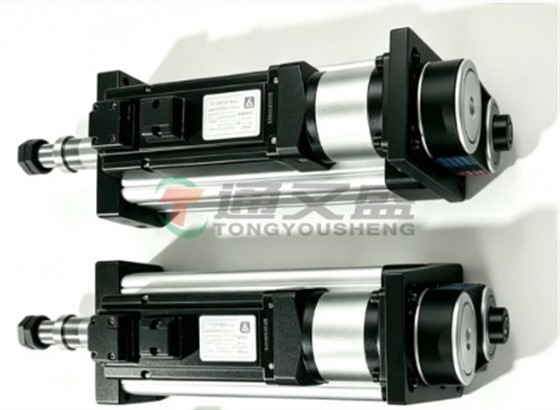
The energy?saving advantage of linear electric cylinders essentially stems from an upgrade in power transmission methods. Unlike pneumatic cylinders (air?driven) and hydraulic cylinders (hydraulically?driven) that rely on medium?based transmission, linear electric cylinders drive the lead screw directly via motors, eliminating intermediate energy conversion stages and cutting energy consumption fundamentally.
1. Energy Consumption Mode: Power?on?demand vs. Continuous Energy Consumption
- Linear electric cylinders: Power is consumed only during motion execution. The motor stays idle under standby status with near?zero energy consumption. For example, in production?line sorting processes, an electric cylinder takes merely 0.5 seconds per stroke and remains standby for the rest of time. Its daily power consumption is only one?fifth of that of a pneumatic cylinder.
- Pneumatic cylinders: They depend on air compressors for constant air pressure. Even when the production line stops, the air compressor has to keep running; otherwise pressure drops and rapid startup becomes impossible. Its 24?hour energy consumption reaches 72?120?kWh, which is 10 times that of a household air?conditioner.
- Hydraulic cylinders: Hydraulic pumps run continuously to maintain system pressure. Energy consumption hits 10?20?kW/h even without any actuation, and extra power is consumed for heat dissipation during oil circulation.
-
2. Transmission Efficiency: Direct Drive vs. Medium?induced Losses
More energy?transfer links mean greater losses — this is the core logic behind energy saving.
- Linear electric cylinders: Direct power flow from motor to lead screw to actuator delivers efficiency above 90?% with barely any energy loss. Servo?driven linear electric cylinders, in particular, adjust power output dynamically according to loads through precise torque control and avoid energy waste caused by over?sized hardware for light?duty tasks.
- Pneumatic cylinders: Energy loss reaches 30?50?% during air compression. Coupled with pipeline leakage, actual transmission efficiency stands at only 40?60?%.
- Hydraulic cylinders: Flow resistance in pipes and valves plus leakage?related energy loss result in roughly 60?70?% transmission efficiency. Efficiency drops further under lighter loads.
3. Maintenance?related Energy Consumption: Low?maintenance vs. High Losses
Maintenance work for conventional drive systems itself generates energy waste.
- Pneumatic cylinders require regular water drainage and filter cleaning, while air compressors need frequent air replenishment. These operations indirectly raise energy consumption.
- Hydraulic cylinders call for periodic hydraulic?oil replacement. Oil waste during oil change and production loss from equipment downtime add the equivalent of 10?15?% extra energy?related costs.
- Linear electric cylinders suffer no medium leakage. Their lubrication interval lasts 6?12 months, and maintenance requires minimal downtime. Maintenance?associated energy consumption is almost negligible.