


As core linear actuators for automated production lines, the service life of precision electric cylinders directly determines equipment uptime, production costs and maintenance cycles. Many enterprises face a common issue: identical precision electric cylinder models can run stably for 3?5?years on some machines, while others suffer stuttering, accuracy loss, lead?screw wear and abnormal noise within merely half a year.
So what is the typical service life of electric cylinders under normal operating conditions?
The service life of precision electric cylinders is mainly measured by reciprocating cycles, operating hours and MTBF (Mean Time Between Failures). Lifespan varies drastically for different cylinder types and working scenarios:
Standard Ball?Screw Precision Electric CylindersUnder light?duty, normal?temperature and dust?free conditions, they can achieve over 20?000 hours of trouble?free operation with more than 5?million reciprocating cycles, delivering stable performance for 3?4?years with proper use.
Planetary Roller?Screw Precision Electric CylindersFeaturing superior structural strength and wear resistance, they offer over 50?000 hours of trouble?free runtime. Their service life is 3?5 times that of conventional ball?screw cylinders. Suited for high?frequency heavy?duty applications, they can operate reliably for 5?8?years.
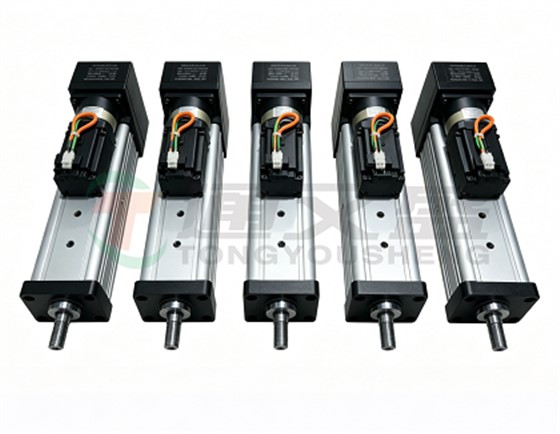
Stepper?motor General?purpose Precision Electric CylindersThey serve 2?3?years under static light?load conditions, whereas their lifespan drops sharply under high?frequency and shock?loaded conditions.
In harsh environments or with improper operation, the actual service life of precision electric cylinders may decrease by more than 50?%. Frequent failures and scrappage within one year are not uncommon.
For precision electric cylinders, product quality accounts for 30?% of service life, while selection, installation and maintenance account for 70?%. Properly operated units can run stably for 3?8?years, yet improper handling may cut their lifespan in half.
To lower equipment procurement costs and reduce production?line downtime losses, there is no need to blindly pursue high?end models. Matching products to actual working conditions, standardizing installation and commissioning, and implementing regular meticulous maintenance can maximize equipment value and achieve long?term cost reduction and efficiency improvement.