


During the selection phase of automated equipment, electric cylinders are mainly divided into two categories: stepper electric cylinders and servo electric cylinders. Many equipment manufacturers tend to confuse the two types at the design stage, resulting in excessive accuracy redundancy that raises costs, or insufficient performance failing to meet production process requirements. Clearly distinguishing the performance differences and applicable scenarios between stepper and servo electric cylinders is critical for building automated motion mechanisms with low cost and high efficiency.
In terms of driving principles, the core difference between the two types lies in their power and control systems.
Stepper electric cylinders are driven by stepper motors and achieve fixed?point displacement transmission via pulse signals. Featuring a simple open?loop control structure and lower overall supporting costs, they deliver stable start?stop response and are suitable for regular linear reciprocating motions. Servo electric cylinders are equipped with servo motors and encoder closed?loop feedback systems, which can correct operating deviations in real time and dynamically adapt to load variations, delivering superior dynamic control performance.
In terms of operating performance, notable gaps exist in process accuracy between the two.
Stepper electric cylinders satisfy basic positioning requirements with no cumulative error, and reliably perform ordinary procedures such as material lifting, simple transferring and packaging pushing. However, minor step?loss may occur under high?speed operation or fluctuating?load conditions. Servo electric cylinders can effectively avoid such issues, boasting higher positioning accuracy and smoother operation. They operate without crawling at low speeds or jitter at high speeds, and fit high?precision processes including precision press?fitting, dimension inspection and micro?displacement alignment.
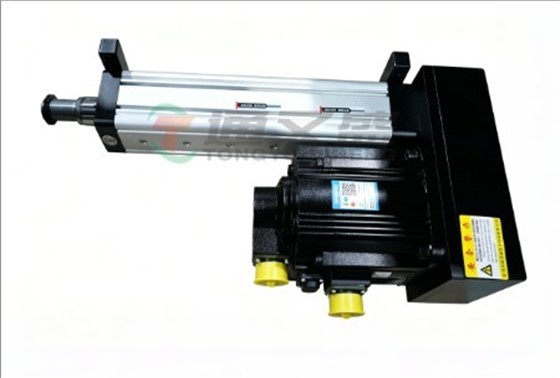
Regarding load and working?condition adaptability, stepper electric cylinders provide steady torque output. They are well?suited for conventional automation scenarios with light loads, constant speed and low operation frequency. With prominent cost?performance advantages, they are a common choice for general non?standard equipment. Servo electric cylinders feature overload protection, constant?force output and dynamic speed regulation. They adapt to complex production conditions with heavy loads, high?frequency cycles and variable loads. Meanwhile, they support complex trajectory programming and multi?device linkage for high?end intelligent manufacturing production lines.
To sum up, stepper electric cylinders are recommended for conventional standard working conditions where cost?effectiveness is prioritized. Servo electric cylinders are preferred for precision production scenarios demanding high accuracy, stability and controllability. Reasonable selection based on actual process requirements ensures stable equipment operation, effectively cuts R&D and production investment, and accommodates automation production needs at different levels.