Avoid sizing high?thrust electric cylinders for full?load and full?stroke operation. Reserve proper safety margins according to working conditions: apply a 1.3?times load margin for normal conditions, and 1.5? to 2?times margin for heavy?duty and shock?loaded applications. Set aside a 10?50?mm safety stroke range for high?thrust electric cylinders, and adopt dual hardware?software limit protection to prevent overload and end?stop impact damage, so as to minimize mechanical fatigue from the very beginning.
During installation of high?thrust electric cylinders, precisely calibrate base levelness as well as coaxiality between motor and cylinder body. Adopt suitable mounting forms for respective applications: flange mounting for vertical pressing, and ball?joint articulation for oscillating conditions. Prevent excessively long cantilevers and fixture eccentricity. Tighten fixing screws diagonally and evenly to eliminate residual installation stress and ensure axial vertical force bearing.
Set maintenance cycles based on operating frequency. For high?frequency?running high?thrust electric cylinders, inspect and replenish grease monthly; perform maintenance every three months for standard?duty units, and conduct complete grease replacement once a year. Use application?specific grease for high?temperature, low?temperature, dusty and oily environments. Remove deteriorated old grease before adding new grease to avoid component wear caused by mixed contaminants.
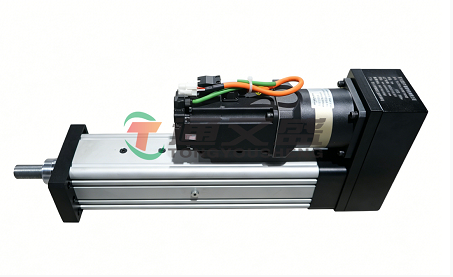
Avoid harsh parameter tuning. Adopt S?curve flexible acceleration?deceleration profiles with appropriately extended acceleration?deceleration time. Adjust servo rigidity and filtering parameters to match loads and eliminate high?speed oscillation and start?stop shock. While meeting production cycle requirements, prevent sustained over?speed and over?rigidity operation of high?thrust electric cylinders to lower dynamic wear.
Select appropriate protection ratings according to workshop conditions: IP65?rated high?thrust electric cylinders for dusty and oily workshops, and IP67 high?protection models for outdoor high?humidity and rain?exposed scenarios. Regularly inspect dust seals and oil seals, and replace aged or damaged sealing components in a timely manner. Block ingress of contaminants and moisture to safeguard internal transmission structures.
Before long?term idling, clean lead?screw surfaces and apply protective grease. Retract the push rod inside the cylinder to avoid exposed oxidation and rusting. Run the high?thrust electric cylinder under no?load condition once per month to prevent grease caking and component seizure. Prior to resuming production, fully inspect sealing, lubrication and operating status, and commence loaded production only after confirming normal conditions.

Address: Room 601, Building 5, Liandong U Valley, No. 1330 Jinfeng South Road, Mudu Town, Wuzhong District, Suzhou, Jiangsu, China
Suzhou TongYouSheng Electronic Technology Co., Ltd. - An ISO9001 Certified Company All rights reserved. Privacy Policy


